

Table of Contents
Dubai has positioned itself as a main business and financial link between the Western economies and emerging markets across Asia, Africa, and the Middle East.
Yet international investors often view the market through the lens of overly optimistic promotional material or earlier impressions of the surrounding regulatory systems. This paper examines the structural, legal, and operational realities of setting up and running a business in Dubai.
The main topics include the practical differences between mainland and free zone jurisdictions, the most recent changes to laws on foreign ownership, the introduction of corporate taxation, banking compliance requirements, and the value of doing business there. When business practices are based on accurate regulatory information, investors will be better positioned to manage the operational trade-offs needed for the long-term viability of their enterprises.
Introduction
The economy of the United Arab Emirates (UAE) has quickly diversified so as to decrease its dependence on the sale of oil and has developed a financial system based on global trade, logistics, financial services, real estate and energy. Dubai plays the role of the region’s business hub.
Even though public advertising frequently emphasizes tax-free conditions and the speed with which businesses can be set up, the actual situation demands careful attention. The legal and economic frameworks of the UAE are currently undergoing modernisation so as to conform to the international standards established by the Organisation for Economic Co-operation and Development (OECD) and the Financial Action Task Force (FATF). As a result, one has to have a clear understanding of the corporate systems, the statutory tax systems, compliance with anti-money laundering (AML) regulations, and the various operational overheads if one is to enter the Dubai market.
1. The choice of jurisdiction: mainland arrangements versus those in the free zone
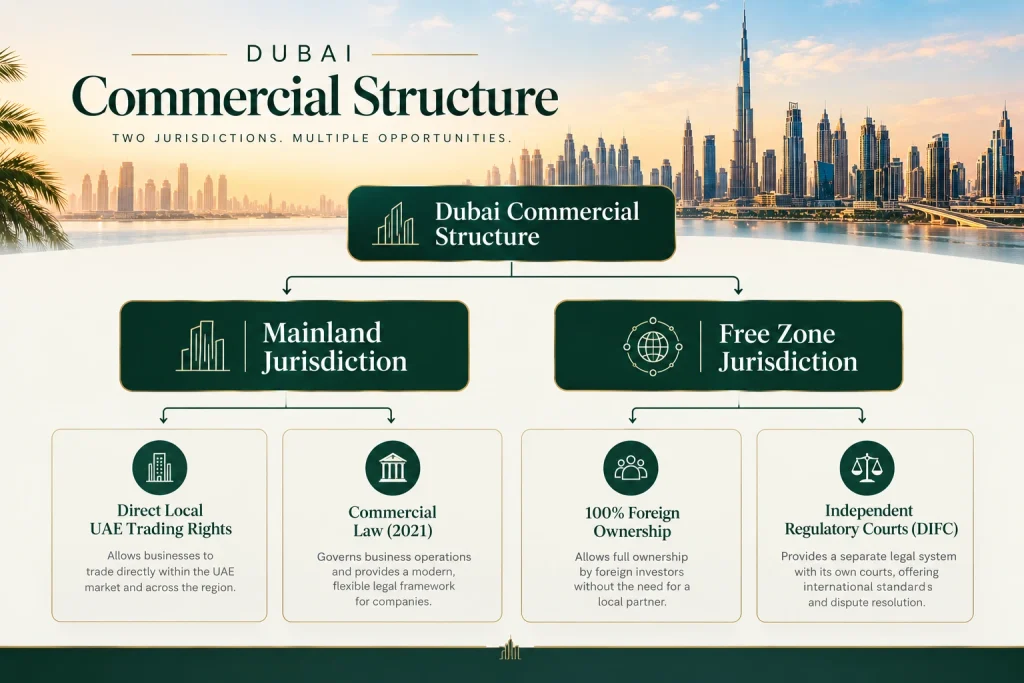
A major structural decision that an investor has to make in Dubai is to select the most suitable legal entity type and jurisdiction. The UAE system splits up commercial jurisdictions into two main categories: Mainland (which is governed by federal industrial laws) and Free Zones (which are governed by independent authority frameworks).
Mainland Entities
The mainland companies are licensed by the Dubai Department of Economy and Tourism (DET), which enables them to carry on business directly in the local UAE consumer market and to obtain government contracts without the need for intermediary agents.
- The requirement, which had previously existed, that a citizen of the UAE should hold a majority of 51% in companies has been removed by the UAE Federal Decree-Law No. 32 of 2021 relating to commercial companies for the vast majority of commercial and industrial activities. Foreign investors are now able to have 100% ownership of Limited Liability Companies (LLCs) on mainland in thousands of approved economic activities.
- The rules concerning strategic activities, especially those relating to security, defence, military matters, and the functions of the central bank, still require specific Emirati ownership or sponsorship.
Free Zone Entities
More than thirty free zones are hosted in Dubai, such as the Dubai Multi Commodities Centre (DMCC), the Dubai International Financial Centre (DIFC), and the Dubai Airport Freezone (DAFZ).
- The operational scope includes a simplified administrative arrangement, allowing for 100 per cent foreign ownership and the imposition of no duties on goods that are re-exported within the free zone; yet free zone companies are legally prevented from carrying out direct trade in services or goods to the mainland UAE market unless they employ a licensed local distributor or set up a branch on the mainland.
- With regard to legal systems, although most free zones function according to the statutory civil law of the UAE, financial free zones such as the DIFC act as independent jurisdictions based on English common law and have their own courts, financial services regulator (DFSA), and employment legislation.
2. Compliance with tax rules and regulations
The idea that Dubai is a completely tax-free area is no longer correct. In order to deal with base erosion and profit shifting (BEPS) the UAE has gradually put in place fiscal frameworks while sticking to international standards.
Corporate Tax Regime
Starting with financial years beginning on or after June 1, 2023, the UAE implemented Federal Decree-Law No. 47 of 2022 relating to the Taxation of Corporations and Businesses:
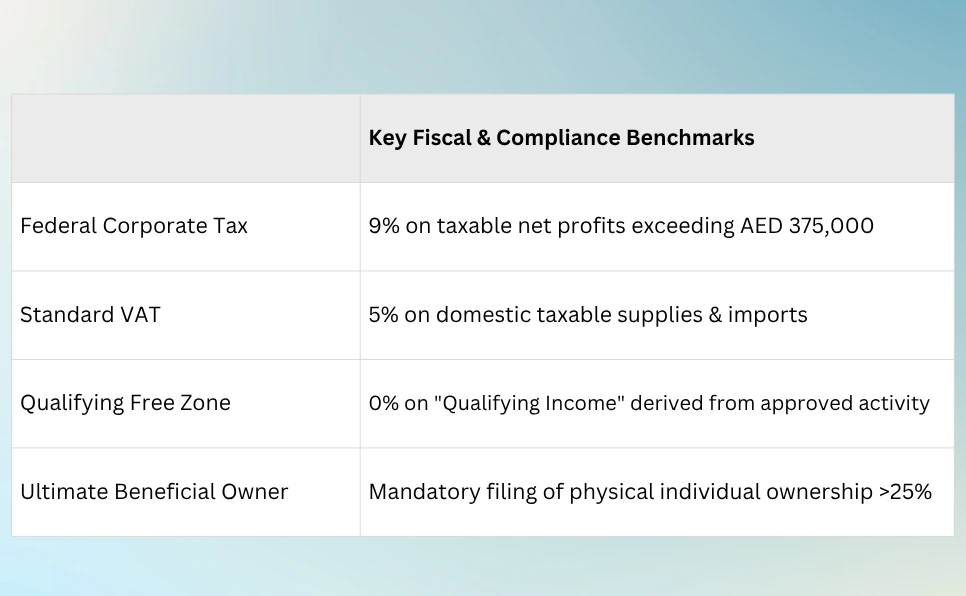
The standard rate is a company tax rate of 9% which applies to taxable net profits that exceed AED 375,000 (approximately $102,000 USD), while profits up to AED 375,000 are taxed at 0% in order to help small businesses and startups.
In the Free Zone, the entities are allowed to have a 0% company tax charge solely relating to ‘Qualifying Income’. In order to achieve this, it is necessary to maintain adequate economic substance in the Free Zone, to earn income from qualifying transactions involving non-citizens or other unconnected entities, and to comply with the transfer pricing regulations as specified by the OECD. Sales that are not qualifying and which arise from transactions on the mainland result in the usual nine per cent rate.
Value Added Tax (VAT)
It was launched in January 2018 as a result of Federal Decree-Law No. 8 of 2017:
A general VAT rate of 5 per cent is usually applied to all goods and services purchased in the United States.
If the amount of taxable items and imports of a business goes beyond the AED 375,000 limit over a period of 12 months, it will be necessary to register, and registration can also be obtained voluntarily at the AED 187,500 level.
Anti-Money Laundering (AML) & Ultimate Beneficial Ownership (UBO)
The United Arab Emirates has made targeted efforts to improve monetary integrity, which is why the strict anti-money laundering regulations (Cabinet Resolution No. Fifty-eight of 2020) require all commercial enterprises to keep registers of their Ultimate Beneficial Owners (UBOs). They must disclose any natural person who holds or controls 25 per cent or more of the organisation’s shares or voting rights.
Three. Operational Realities: Banking, Overhead, and Visas
While incorporating a criminal entity in Dubai can take anywhere from a few days to 2 weeks, setting up operations requires navigating practical administrative friction points.
Corporate Banking Friction
For foreign buyers the process of opening a bank account with an operational company in the UAE remains one of the most difficult procedural steps.
Because of the global FATF standards, the monetary institutions in the UAE have implemented strict Know Your Customer (KYC) procedures.
Banks require clean proof of a physical operational presence (favouring workplace leases over flexi-desks in the case of profiles with a high level of risk), full enterprise plans, evidence of the commencement of financial activities, and documented trading histories/contracts. The typical length of account approval cycles is between four and twelve weeks.
Cost of Capital and Real Overhead
The initial incorporation fees (usually quoted between AED 12,000 and AED 30,000) are only part of the total startup costs. The annual recurring obligations are as follows:
- Renewals of trade licenses require the payment of annual mandatory fees set by the government.
- The allocation of physical space is mandatory and involves assigning either an E-Desk, a Flexi-Desk, or office premises that are directly linked to the visa quota allocations.
- Employee residence visas require establishment cards and medical audits in order to be processed.
Visa Frameworks
Employment and residence in Dubai are managed through structured immigration pathways:
- Investor/partner visas are given to shareholders who hold equity in companies based in the UAE and remain valid for either two or three years.
- The Golden Visa is a residency visa with a fixed term that can be renewed, aimed at real estate investors (whose property is worth AED 2 million or more), specialised talent, and specialised technical talents, without the need for a local employer to sponsor them.
- The Green Visa is a five-year residency route designed for skilled professionals, freelancers, and business partners.
Key Takeaways for Investors
- Build a strong business structure before worrying about location and match your legal setup to your revenue streams. For local retail, B2C services, or government tenders in the UAE, a Mainland LLC is your best bet. If you focus on international trade, SaaS, or cross-border B2B advisory, a Free Zone setup will streamline your operations.
- Account for the 9% Corporate Tax Base: Include corporate tax compliance in financial modelling. Revenue generated in the mainland market will attract the standard 9% tax once profit exceeds AED 375,000.
- Factor Banking Timelines into Capital Runways: Do no longer anticipate instant financial institution account activation after receiving an alternate license. Plan a 1- to a few-month operational buffer for banking approvals before counting on neighbourhood coins go with the flow.
- Look Beyond Base Incorporation Quotes: Calculate full annual operating costs including trade license renewals, required physical office space, annual audits, and visa protection, rather than relying on initial setup package costs.
- Establish Verifiable Economic Substance: Shell entities without physical infrastructure, local workforce, or effective board control hazard losing unfettered sector tax benefits and face scrutiny in corporate banking opinions.
Reference List
Ministry of Economy – UAE. (2021). Federal Decree-Law No. 32 of 2021 on Commercial Companies. United Arab Emirates Government.
Ministry of Finance – UAE. (2022). Federal Decree-Law No. 47 of 2022 on the Taxation of Corporations and Businesses. United Arab Emirates Government.
Federal Tax Authority – UAE. (2017). Federal Decree-Law No. 8 of 2017 on Value Added Tax. United Arab Emirates Government.
Cabinet of the UAE. (2020). Cabinet Resolution No. 58 of 2020 on the Regulation of the Beneficial Owner Procedures. United Arab Emirates Government.
Dubai Department of Economy and Tourism (DET). (2024). Mainland commercial licensing and foreign ownership guidelines. Government of Dubai.