
Table of Contents
An American investor who is earning a net return of 3.5% from a property investment in Manhattan, or one who is watching as prices in Miami have stopped rising after the period of post-pandemic boom, now notices that Dubai property listings are citing gross yields of 8% together with no capital gains tax. Therefore, is Dubai real estate a good investment for Americans, or is this just a sales pitch disguised as market data?
At Oludxb we are in this market every day without having to wait for a commission cheque as a result of your choice. The following presents a straightforward examination of the ownership rules applicable to US citizens, the actual figures as they stand in different areas in 2026, what the IRS requires of you no matter what the UAE tax regulations are, how financing functions when you are a non-resident buyer, and where the genuine risks lie.
By the end of this discussion, you should have a basis on which to make up your mind about whether Dubai real estate should be included in your investment portfolio.
What American buyers can legally own in Dubai
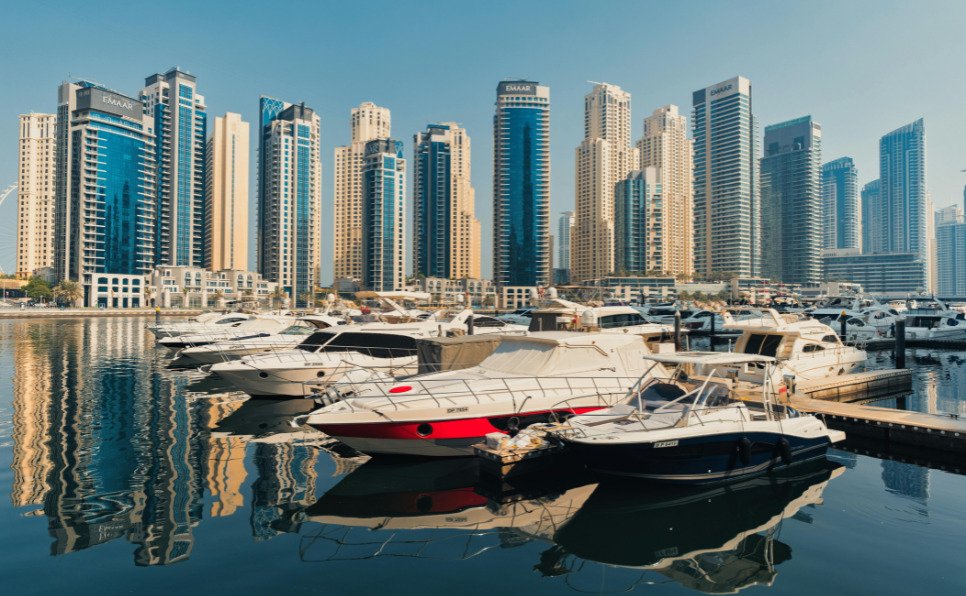
Foreign nationals, such as non-resident US citizens, are allowed to own property in Dubai in certain designated freehold areas which are regulated by the rules of the Dubai Land Department (DLD). The main areas are Downtown Dubai, Dubai Marina, Palm Jumeirah, Business Bay, Jumeirah Village Circle, Dubai Hills Estate and Dubai Creek Harbour. In this case, freehold refers to a title that is perpetual and not a lease of limited duration. The only document that proves your ownership is the DLD title deed; a developer’s marketing brochure has no legal value.
A freehold owner who is registered has the right to sell, give as a gift, lease it, mortgage it, and leave it to someone else by will. It does not, however, give the right to make unlimited modifications, since building regulations and the rules of the owners’ association still apply. Furthermore, simply owning freehold title does not automatically result in UAE residency.
Although eligible property investment can be used when applying for a visa, residency is the result of a separate immigration procedure with its own eligibility requirements and is not something that comes as a benefit with the purchase.
Certain developments provide usufruct (for a period of up to 99 years) or long-term leasehold instead of full freehold. Although these arrangements are valid they have different consequences when it comes to resale and succession. It is essential that you check the title structure against the DLD records before signing anything.
Is Dubai real estate a good investment for Americans?, returns and risks
It is in the yield comparison that Dubai proves to be genuinely attractive to American investors. The prime areas, for example Downtown Dubai, Dubai Marina and Palm Jumeirah, offer gross yields of 4.5 per cent and 6.5 per cent with occupancy rates of 95 per cent and 96 per cent respectively.
The mid-market areas such as Jumeirah Village Circle, Dubai Silicon Oasis and Al Furjan yield 6 per cent and 8 per cent gross with occupancy rates of 92 per cent and 94 per cent. Net yields are about 1.5 to 2.5 percentage points lower than the gross yields after allowing for service charges, management fees and vacancy. When this is compared with a typical New York City buy-to-let property which has a net yield of 2.5 per cent to 4 per cent, or one in Miami with a net yield of 3.5 per cent to 5 per cent, the structural advantage becomes obvious.
The increase in prices introduces a new aspect to the picture. Apartment prices across the city rose by about 11.2% on an year-on-year basis over the 12 months ending March 2026, while villa prices increased by 14.7% over the same period. The most striking figure is that of Palm Jumeirah, which climbed from around AED 1,200 per square foot in the first quarter of 2021 to more than AED 4,200 per square foot in the first quarter of 2026. Mid-market JVC is currently at AED 1,455 and 1,510 per square foot, representing year-on-year increases of 10% and 12% respectively. Downtown Dubai is at AED 3,011 and 3,200 per square foot, an increase of 13%.
The strongest case for total return is found in well-established mid-market freehold areas, where property entry prices are still under AED 2 million and rental demand is driven by tenants rather than by speculation. In the premium segments, entry prices have already become high and forward price appreciation is slowing down to a projected 7% for the full year 2026. Although this figure still comfortably outperforms that of Miami and New York City, the easy compounding effect seen during the 2021 and 2024 cycles has by now mostly been realised in the prime tier.
Tax implications for US owners
The United Arab Emirates does not levy a personal income tax on rental income, no capital gains tax when properties are sold, and no annual property tax on ownership. For an American who is used to facing federal capital gains rates of 15 or 20 per cent together with state taxes and continuous property tax bills, this represents a significant advantage in terms of the overall structure when leaving the country. The benefits are genuine.
The fact that the IRS doesn’t disappear just because Dubai doesn’t impose taxes means that you have to report your rental income on Schedule E of your Form 1040, and since the UAE does not levy income tax on that rental income there is no foreign tax credit against your US tax liability.
When the shares are on sale, the gain is determined in US dollars using the exchange rates that apply at the date of the transaction and is then reported on Form 8949 and Schedule D. Gains from property held for more than one year are taxed at either 0%, 15%, or 20% according to your taxable income, and an additional 3.8% Net Investment Income Tax may apply if your modified adjusted gross income is above $200,000 (if you are single) or $250,000 (if you are married and filing jointly). Moreover, the currency conversion calculation can result in an unexpected taxable gain even if the AED value has not changed significantly.
The property in Dubai is not considered a foreign bank account reportable asset, but if any account in the UAE is used to receive rent or pay out expenses it will be reportable provided that the total balance in foreign accounts exceeds $10,000 at any time during the year. In the case where the property is held through a foreign company, an LLC or a trust, a number of further filing requirements arise: forms 5471, 8865 and 3520 having to do with the particular structure, together with the fees of professionals needed to prepare these forms. You should consult a US international-tax certified public accountant before you sign the sale agreement, not after the fact. Consider US tax compliance to be a fixed cost of ownership.
Financing Dubai property as a foreigner
In 2026 non-resident buyers in the US will be able to get mortgages in Dubai, but the availability is more limited than it is for residents and the conditions are more stringent. The banks that offer programmes for non-residents are HSBC UAE, Emirates NBD, Standard Chartered UAE and Mashreq.
A maximum loan-to-value ratio of 60 or 65 per cent will apply to completed freehold property, which means that a minimum deposit of 35 or 40 per cent is required before fees are taken into account. Fixed-term mortgages for non-residents usually have rates of 4.5 or 6.2 per cent; variable rates are set at approximately EIBOR plus 2 or 3.5 per cent, and with the current 3-month EIBOR at about 4.22 per cent this works out to an effective rate between 6.2 and 7.7 per cent. Financing for off-plan purchases is generally not available until handover and DLD registration has taken place.
In addition to the deposit, allow for 10% of the property value when budgeting for transaction costs. These costs consist of the DLD transfer fee (4% of the purchase price), mortgage registration (0.25% of the loan amount), an arrangement fee (about 1% of the loan), property valuation (AED 2,500 or 3,500), and a trustee and registration service fee (around AED 4,000 plus VAT). For a property valued at AED 3 million with a loan-to-value ratio of 60%, the total amount needed would be roughly AED 1.2 million for the deposit and an additional AED 210,000 or AED 300,000 for transaction costs before the first rent cheque is collected.
Risks that can erode your Dubai returns
There has been a pattern in Dubai of constructing properties before there is actual demand. A large number of units that are still under development will be completed during 2026 and 2027, with this being especially true of mid-market areas. When new housing is introduced in a specific neighbourhood, it can lead to a decrease in both rental prices and the resale values over a 12 or 24-month period. It is important to always use a conservative estimate for rentals rather than the yield that is advertised, particularly in regions where there is a heavy amount of unsold units pending delivery.
The value of the AED is linked to that of the USD, thereby eliminating any direct day-to-day exposure to exchange rate fluctuations. Even when transferring large amounts from sales or accumulated rent to a US account, wire compliance checks, documentation requirements and, in certain cases, an examination of the source of the funds are still necessary. None of these obstacles is insurmountable, but they do require advance planning rather than making a last-minute request to your bank.
The risk of liquidity is one that most investors fail to take into account. It takes a while to sell a property in Dubai, there are fees on both the seller’s and the buyer’s sides, and it also depends on whether buyer financing is available at that particular point in the market. If your approach is based on short-term rental income rather than on annual tenancies, then DTCM licensing introduces an extra regulatory requirement: each unit must have its own DET Holiday Homes permit before it can be advertised or occupied, and this permit has to be renewed every year. A change in the licensing rules can therefore have a material impact on the yield assumptions that are based on returns from holiday lets rather than on long-term leases.
Five questions to answer before you proceed
Dubai’s real estate can indeed constitute a competitive investment for American buyers, provided that you have honestly considered the following points.
- Could you comfortably pay 40 to 50 per cent of the property price in cash (that being the deposit plus the transaction costs) without using any of your existing assets as leverage?
- Have you calculated the net yield taking into account the service charges, the management fees, and the US tax liability, rather than just the gross yield that the broker quoted?
- Have you actually checked the DLD freehold title structure, not merely the developer’s marketing description?
- Have you ever spoken to an American international-tax certified public accountant who is knowledgeable about foreign real estate, FBAR, and the requirements listed on Schedule E?
- Are you based on a well-defined investment strategy for the five to ten year period or are you simply buying because of recent price movements?
The thing to finish before hiring an agent or looking at floor plans should be any of these that are still listed as ‘not yet’.
Oludxb goal is not the sale of properties, The function of this platform is to explain, in simple terms, what Dubai real estate is really like when viewed neighbourhood by neighbourhood. If you want to know the difference between investing in JVC and Business Bay, or what it actually amounts to day by day to manage a property in Dubai from within the United States, you should begin with this resource before consulting anyone who has a commission to earn.
In short, is Dubai real estate a good investment for Americans?
Dubai’s real estate provides genuine structural benefits to American investors, such as high gross yields, the absence of a local capital gains tax, no property tax, and a transparent DLD registration system which truly safeguards freehold ownership. The investment, however, is not one that requires little effort or can be left entirely alone when you take into account the obligations relating to US tax compliance, the high acquisition costs, financing difficulties for non-residents, and the existing supply risks in some areas.
The issue isn’t whether Dubai is a good market in an abstract sense; it’s whether it suits your capital position, your tax circumstances, your time frame, and your tolerance for managing property from the other side of the world. Investors who honestly answer those questions and make proper preparations will discover that Dubai real estate is a highly competitive investment option; those who omit the preparation tend to learn why it’s important only the hard way.
Yes, for the right investor, but the part about being honest isn’t optional.