
Table of Contents
The investment pitch decks for Dubai real estate point out some attractive figures, such as gross yields ranging from 6% to 9%, the absence of income tax, strong capital appreciation, and solid population growth. Yet when international investors and portfolio managers calculate net rental yields solely on the figures provided by the Dubai Electricity and Water Authority (DEWA), they usually encounter a sudden narrowing of their margins.
One main reason for this gap is how district cooling systems, often called “chiller charges”, are structured as operating costs. In the master-planned communities located in Business Bay, Dubai Marina, Downtown Dubai, and Jumeirah Beach Residence (JBR), central cooling systems operated by utility companies such as Emirates Central Cooling Systems Corporation (Empower), Emicool, and the National Central Cooling Company (Tabreed) involve substantial fixed monthly overheads. If these costs are misallocated or overlooked during lease negotiations, the property’s net operating income (NOI) can suffer significantly.
Understanding the Economics of District Cooling
If we are to examine the effect of district cooling on asset yields, then we must look at how the providers’ tariffs are structured. Different from traditional individual air conditioning systems in which power consumption is billed using a single DEWA meter, district cooling is based on a dual-tariff system:
1. Consumption Charges (Variable)
The charge reflects the actual thermal energy used by the unit and is expressed in Refrigeration Ton Hours (RT-hours). The standard market rate is approximately AED 0.568 per RT-hour, together with fuel surcharges and value-added tax (VAT). In the case of standard tenancy agreements, the occupant who is actively using the space is responsible for paying for this variable consumption.
2. Capacity / Demand Charges (Fixed)
The fee includes the capital expenditure and the necessary infrastructure preparation needed in order to provide cooling capacity to the property throughout the year; the tariff is fixed at 750 dirhams per Refrigeration Ton (RT) per year and is billed monthly, irrespective of whether the apartment is occupied or the air conditioning is switched on.
| DISTRICT COOLING TARIFF MODEL |
| Consumption Charge (Variable) | Capacity Demand (Fixed) |
| Rate: ~AED 0.568/RT-hr | Rate: AED 750/RT/year |
| Paid by: Active Tenant | Billed 365 days/year |
| Based on actual usage | Tied to unit size |
In the case of a typical two-bedroom residential property with a cooling capacity of 6 RT, the annual demand charge amounts to AED 4,500, while extra regular charges, such as meter maintenance fees (AED 30 per month) and the standard fuel adjustment surcharges, result in additional fixed costs being included in the bill.
Evaluating the Yield Compression Mechanism
The main operational problem that landlords face is the contractual assignment of these fixed capacity charges. When properties are leased in areas that are district-cooled, the leases generally adopt one of three types of arrangements:
| LEASING STRUCTURE RISK PROFILES |
| Chiller-Free Arrangement | Split-Bill Arrangement | Tenant-Paid Arrangement |
| Landlord absorbs all cooling costs (High Yield Risk) | Landlord covers capacity fee; Tenant pays usage | Tenant assumes total utility bill (Lowest Risk) |
1. The “Chiller-Free” Premise
In order to stand out in a competitive rental market, property owners often advertise their units as “chiller-free”, agreeing to pay the tenant for the cost of cooling. In reality, this means that both the variable costs relating to usage and the fixed demand obligations are completely passed on to the property owner. During the peak summer months the total monthly cooling costs for a typical unit can easily exceed 1,800 AED, resulting in an unplanned reduction in rental income.
2. Vacancy Friction
In the case of turnover periods or when there is an extended marketing phase, electricity consumption that is variable falls to zero, but the fixed demand charge is still applicable. Where building developments are governed by the guidelines of the Real Estate Regulatory Agency (RERA), the legal titleholder remains fully responsible for keeping the utility service accounts in order. A vacancy lasting two months in a premium apartment can result in a loss of AED 1,000 to 1,500 in rental income simply because of the basic utility costs.
3. Tenant Resistance and Default
If leases specifically require tenants to register district cooling accounts in their own names, the first security deposit (which varies between AED 2,000 and AED 3,000) together with the activation fees may lead to resistance from tenants when negotiating the terms. In the event that a tenant fails to make the payments, the utility companies have the right to cut off the service and charge both a disconnection fee and a reconnection fee (each usually amounting to AED 1,000), complications which property owners have to deal with in order to clear the title for the next tenancy cycle.
Financial Analysis: Individual Chiller vs. District Cooling
To quantify how cooling infrastructure affects net financial performance, consider two identical residential apartments in Dubai bought at equivalent market values, each generating an annual gross rent of AED 120,000.
| Financial Parameter | Asset A: Individual AC (DEWA Direct) | Asset B: District Cooling (Empower/Emicool) |
| Purchase Price | AED 1,500,000 | AED 1,500,000 |
| Gross Annual Rent | AED 120,000 | AED 120,000 |
| Gross Yield | 8.00% | 8.00% |
| Service Charge (RERA Index Avg.) | AED 18,000 (AED 15/sq. ft.) | AED 18,000 (AED 15/sq. ft.) |
| Annual Fixed Capacity Charge | AED 0 (Included in DEWA/Service Fee) | AED 4,500 (6 RT @ AED 750/RT) |
| Meter Maintenance & Surcharges | AED 0 | AED 540 |
| Vacancy Overhead Allowance (1 Mo.) | AED 0 (DEWA basic connection) | AED 420 (Fixed demand fee during turnover) |
| Total Annual Expense | AED 18,000 | AED 23,460 |
| Net Rental Income | AED 102,000 | AED 96,540 |
| Net Realized Yield | 6.80% | 6.43% |
In this realistic situation, the fact that there are unrecovered costs associated with the district cooling infrastructure leads to a decrease in the yield of Asset B by 37 basis points, and over a normal five-year period of investment holding this structural shortfall amounts to a net cash flow deficit that goes beyond AED 27,000 per unit.
Asset Management Strategies for Landlords
Property investors can implement several practical asset management steps to mitigate yield erosion from district cooling liabilities:
Contractual Clarity in Unified Leases
Standard Ejari lease agreements should explicitly define utility responsibilities. Ensure that tenancy clauses explicitly split variable and fixed costs:
The Tenant promises to register the district cooling account directly with the provider at the time the lease starts and will be fully responsible for all the ongoing consumption charges, fuel surcharges, and monthly demand capacity charges during the term of the occupancy.
Pre-Acquisition Due Diligence
When carrying out the property acquisition screening, ask the seller for the audited, itemised schedules of service charges. Check whether the building’s main community service fee covers the operation of the central cooling plant or whether the individual owners get separate utility bills from companies such as Empower or Tabreed.
Value-Add Upgrades
In older buildings that have inefficient chilled water valves, the fitting of modern smart thermostats and thermal zone controls can lead to a reduction in total cooling consumption by 15 to 25 per cent. This decrease in peak consumption also helps to avoid disputes over tenant bills and keeps the property attractive in the event of resale.
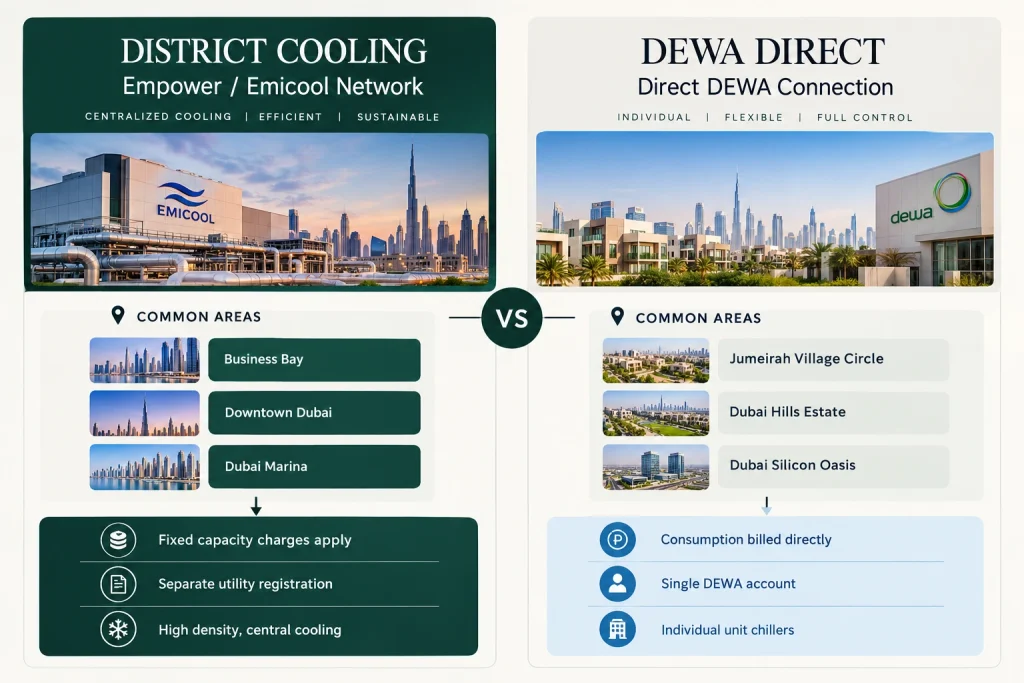
District cooling systems provide real macro-environmental benefits since they comply with the Dubai 2040 Urban Master Plan by lowering total urban power consumption and reducing stress on the grid. The fact remains, though, that real estate investors have to take the two-tier billing system into consideration when drawing up lease agreements.
Portfolio managers will be able to safeguard their baseline rental cash flows from unexpected overheads by modifying the lease terms, checking the breakdown of the service fees, and incorporating the fixed demand charges into the target acquisition pricing.